About
Australian Cancer Nursing
Capability Framework
Known as the AusCaN Framework — a shared national standard for the cancer nursing workforce, supporting every nurse to deliver their best.
What It Is
The AusCaN Framework is a nationally developed resource that defines the knowledge, skills and professional behaviours expected of nurses working in cancer care across Australia.
It is intended to be a living document: a practical, accessible, and aspirational resource that cancer nurses, employers, educators, and health services can use to support professional growth, career development, workforce planning, and the design of education programs. Equitable access to professional development irrespective of location, setting, or background is a core commitment of the Framework.
Who It's For
The AusCaN Framework has been designed for Registered Nurses at all levels who work with people affected by cancer, whether in dedicated cancer care settings or in general health care contexts. It articulates the capabilities (knowledge, skills and behaviours) that define contemporary cancer nursing practice at essential, specialised, and advanced levels.
The Framework applies across all geographic settings, clinical environments, and models of care in which cancer nursing takes place in Australia, including metropolitan and rural/regional settings, public and private health services, community-based care, telehealth, and research settings.
How It Was Developed
The AusCaN Framework has been developed through a collaborative partnership between the Cancer Nurses Society of Australia (CNSA) and Flinders University, with input from a broad national advisory committee and the Australian cancer nursing community and sector leaders through a rigorous national consultation and consensus process, grounded in current best-practice evidence. The development process comprised two phases.
Literature Reviews, Consultations and Preliminary Framework Development
A scoping review of international cancer nursing frameworks was conducted to provide a systematic overview of existing frameworks and map key capabilities and competencies across the four pillars of practice.
This was complemented by analysis of the CNSA national cancer nursing workforce survey findings, a survey of Australian Cancer Nurses self-perceived educational priorities and consultation with more than 100 cancer nursing stakeholders, including patient advocates across Australia.
Based on this work, the project team generated a comprehensive preliminary set of capability statements spanning the four pillars of cancer nursing practice: Clinical Practice, Education, Leadership and Management, and Research and Innovation. Each capability statement describes the knowledge, skills, and behaviours required at one of three levels – Essential, Specialised, and Advanced – with each level building on and encompassing all preceding levels.
National Expert Consensus via Modified Delphi
The second phase employed a modified Delphi consensus process to develop and refine the capability framework with Australian cancer nursing experts. Eighty cancer nurses drawn from all states and territories participated in two structured online survey rounds. Participants represented the breadth of the cancer nursing workforce, including clinical nurses (49%), managers and executives (26%), educators (17.5%), and academics and researchers (7.5%).
In Round 1, participants categorised capability statements according to the practice level at which they should be demonstrated (Essential, Specialised, or Advanced). In Round 2, participants rated their agreement with each statement that had not met categorisation consensus in Round 1 using a five-point scale. After Round 2 and further consultation and consensus meetings with the Advisory Group and other clinical experts a total 149 capability statements were included in the final AusCaN Framework.
Further Reading
Project Team
Lead contributors to the AusCaN Framework development.

Dr Carla Thamm
PhD, RN, BN (Hons), Grad Cert (Cancer Care), MN (Practice)
Senior Research Fellow – Clinical Lead (Cancer Survivorship Program)
Caring Futures Institute, College of Health and Enablement, Flinders University SA

Professor Gemma McErlean
Professor of Cancer Nursing
School of Nursing and Midwifery, Faculty of Health, University of Technology Sydney
Nelune Comprehensive Cancer Centre, Prince of Wales Hospital (SESLHD)

Professor Catherine Paterson
Professor of Cancer Nursing, Nurse Practitioner
Co-lead Cancer Survivorship Research Program
Caring Futures Institute, College of Health and Enablement, Flinders University
Framework Advisory Group
CNSA Governance Group
"One Workforce. Many Roles. Shared Capability. Extraordinary Impact."
Australian Cancer Nursing Capability Framework — AusCaN Framework Vision
Ecosystem
Cancer Nursing Ecosystem — Capability Across the Whole Workforce
Everyone contributes. Everyone advances. Better outcomes for people affected by cancer.
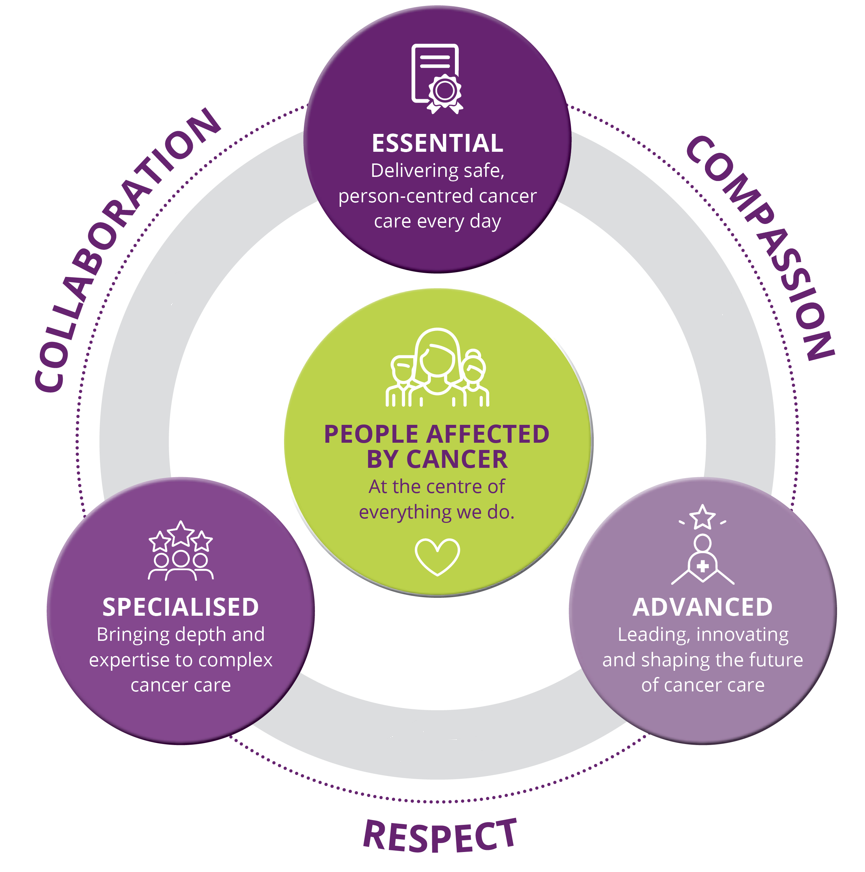
Click a circle to explore each level
Our Purpose
Delivering safe, equitable and person-centred cancer care through a connected, capable and supported nursing workforce.
Our Enablers
- Education & lifelong learning
- Mentorship & peer support
- Career pathways & progression
- Evidence, innovation & research
- Leadership & workforce wellbeing
- System support & policy
Our Impact
- Better experiences for people affected by cancer
- Better outcomes across the cancer continuum
- Equitable access to expert care
- Stronger, future-ready workforce
- Sustainable cancer services
One workforce. Many roles. Shared capability. Extraordinary impact.
Connected Frameworks
Frameworks That Support Our Capability
These frameworks don't sit at a single level — many span multiple stages of practice. Hover a level or click a framework to explore.
Palliative Care Nurses Australia
Specialist Cancer Nurse Self-assessment tool (CaN-SAT)
McGrath Foundation and Monash University
Capability development is not linear. Frameworks like Cultural Safety, Digital Health, Survivorship, and WHO Educator Competencies are woven through every stage — from your first year to advanced leadership.
Framework
A Progression of Capability
Four tiers, four domains. Each level builds on the last – from foundational practice through advanced leadership and innovation.
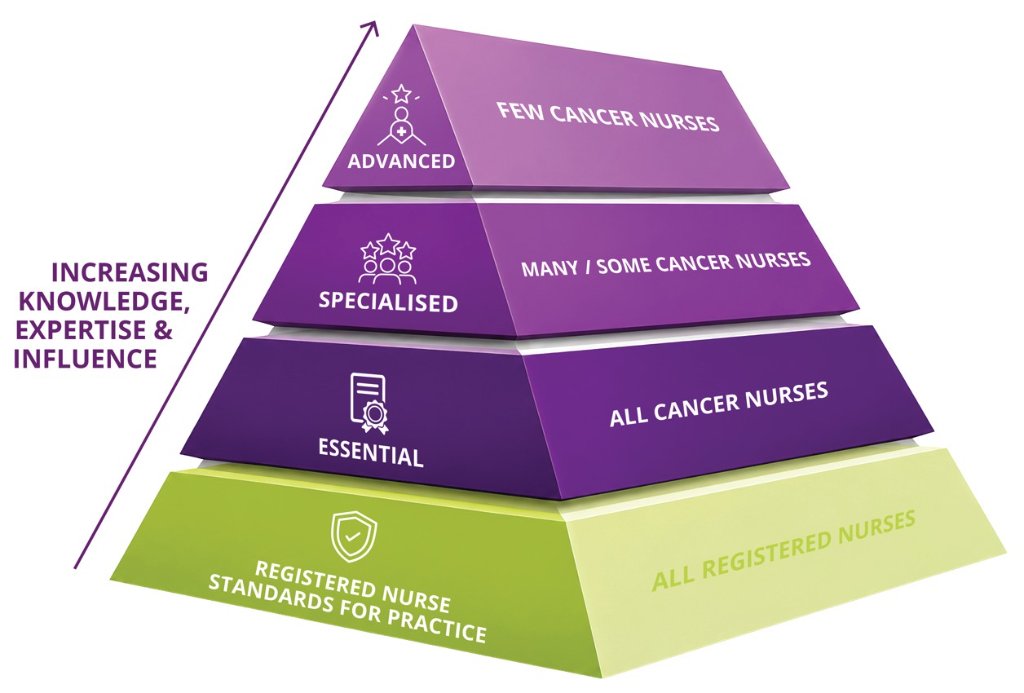
Click a tier to explore each level
Explore Each Level
Framework Structure
Four Interconnected Domains
Capabilities radiate from Essential at the centre through to Advanced at the outer ring — across four colour-coded domains. Select a domain on the wheel or below to learn more.
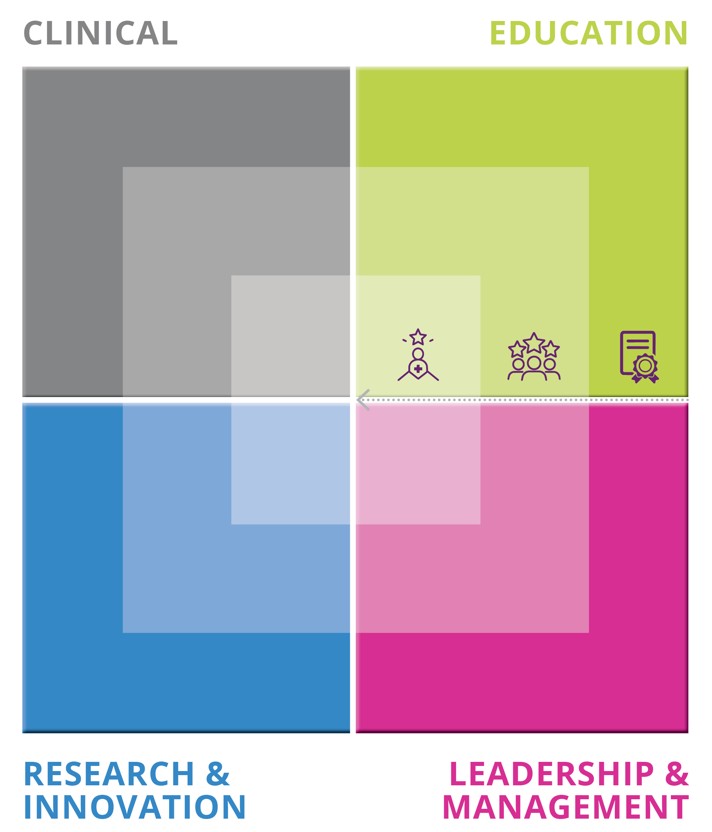
The AusCaN Framework organises cancer nursing capabilities into four interconnected domains. Select a domain to learn more.
Interactive Capability Explorer
Browse the Full Capability Framework
Search, filter by level, and explore all 149 capability statements across 4 domains, or download the full framework.
149
Total
53
Essential
66
Specialised
30
Advanced
Real Nurses. Real Pathways.
The Framework in Practice
These case studies illustrate how the AusCaN Framework applies to nurses at different stages of their cancer nursing journey — from first day in oncology to experienced clinician entering a new context.
Mia
Newly Graduated Registered Nurse
General Medical Ward, Metro Hospital
Mia graduated six months ago and recently started a rotation in the oncology ward. She has limited experience caring for people with cancer and is building her foundational knowledge from scratch.
James
Registered Nurse — New to Cancer Care
Outpatient Cancer Centre, Regional Health Service
James has five years of experience in emergency nursing and recently transitioned into a cancer outpatient centre. He brings strong clinical skills but is new to the specific demands of oncology.
These case studies are illustrative personas created to demonstrate the AusCaN Framework in action.
Implementation Toolkit
Everything You Need to Get Started
We are working on practical resources, templates and guides to help individuals, teams and organisations implement the Cancer Nursing Capability Framework with confidence.
Getting Started
Self-Assessment & Reflection
Workforce & Team Planning
Education & Onboarding
Governance & Reporting
Implementation Support coming soon!
Contact CNSA to express interest and we'll be in touch.
Contact UsSelf-Assessment Tool
Where Are You in Your Cancer Nursing Journey?
The research team are committed to working with the profession to make sure this is fit for purpose. If you'd like to be involved in development, please reach out to the CNSA team — contact us here.
Coming soon
A self-assessment tool mapped to all four capability domains — Clinical, Education, Leadership & Management, and Research & Innovation — to help nurses identify strengths and prioritise their professional development.
Higher Education
Education Directory
We are committed to providing a comprehensive directory of postgraduate qualifications mapped to the Cancer Nursing Capability Framework. We will update this directory after we complete a horizon scan of current offerings across Australia.
Looking for CPD, short courses or online modules?
For continuing professional development, short courses, and cancer nursing resources, we've partnered with Florence — your dedicated platform for CPD tailored to cancer nurses.